top of page
Phase 04
Analysis & Reflection Prompts
1.
In Kitchen Stories, Anna Puigjaner Wheelwright discusses the culture of shared domestic spaces and collective kitchens. Referring to your previous work/study, compare how have traditional spatial typologies differ through cultures and/or changed over time. How might you adapt these changing typologies for your project?
Reflection on Century of the BedAs more and more young people become "attached" to their beds, architects must consider how this sensitive feature may alter our perceptions of home. Beatriz Colomina's idea was inspired by the fact that 80% of young professionals work from their beds. It expresses the growing importance of a bed among all of our everyday possessions. Many of us assume that our bed is the centre of our home activities, but our bedrooms do not take precedence in any family's interior design. A hotel suite, with all components surrounding the sleeping area, is the greatest place to demonstrate her concept. It should come as no surprise that our future home follows the same logic as a hotel suite. The name "bedroom" is dropped in Colomina's experiment (below), and there would be no barrier between the bed (heart of life) and the dining/kitchen/working rooms.
2.
Beatriz Colomina’s ‘Century of the Bed’ describe the multiplicity of function and purpose of the object and room. Select one of the exhibition writeups and identify key points of interest. How might this interpretation differ between individual and collectives within shared spaces?
Anna Puigjaner discusses her experience exploring local domestic dwellings around the world in her talk. She usually looks at the typology of occupants traversing utilitarian spaces (kitchens, bathrooms, etc.) in traditional ways. She went inside urban collective flats in Canada and Japan, as well as towns with more vernacular lifestyles in Peru and Mexico.
As a result, these groups frequently share a communal kitchen and dining area as an extension of neighboring families. A communal kitchen has unrestricted influence over the surrounding community, including the general public.
People who take part in such a collaborative process are more likely to have a sense of belonging, unity, and social involvement. Rather than being limited by the urban network, domestic life is an element that defines it. In her proposal for a "kitchenless city," Puigjaner aspires to "move the kitchen out of the house." Her concerns about the private kitchen stemmed from a number of facts: piles of unused kitchen supplies, a slowing rate of cooking, ineffective house cleaning, and so on. She also mentions that an adaptable and evolutionary community interaction would be a solution that would lead to a more efficient and socially caring urban typology.
3.
What is your project about?
Compose a revised personal design statement of five sentences [Week 6] explaining your design concept including a response to thematic developed over the semester.
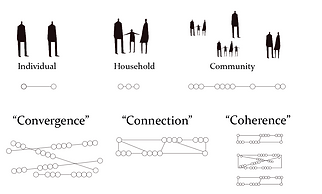
Humans are outdoor animals. This is a non-hierarchy community that aims to offer residents the sense of connectivity, security and human-based facilities. This “Converging Community” welcomes diversity, ecology and sustainability. Any demographic group within, either individual or household are able to enjoy a range of green spaces, convenient facilities and interpersonal experience generated from the community design.
EPSILION JOURNAL PHASE 04 EPSILION JOURNAL PHASE 04 EPSILION JOURNAL PHASE 04 EPSILION JOURNAL PHASE 04 EPSILION JOURNAL PHASE 04
bottom of page